Saturday, July 3, 2010

Funny the Way It Is

I was watching the Mets vs. Nationals game on Fox this afternoon, and noticed how distracted television is sometimes. The game was on the screen, but also on the screen was a yellow box running an ad for the upcoming All-Star game (on Fox) that we were required to read, I assume. While all this is going on, the play-by-play announcer was entertaining us with a random baseball story that had nothing to do with either what was happening on my TV screen or on the playing field.
I think that the only way Fox could have created a more mentally distracting sight would have been to run loud music over the entire thing. That, or they could have tilted the screen a little so that I would have to move my head. Now they have another new idea.
And then, there was an ad for a Dodge truck whose big selling point was that it had a cargo bay "capable of holding 5.5 pounds of chili." Really, that's what he said. It's gotten to the point that chili storage is a positive trait in a vehicle. Here I was, concerned about fuel mileage or handling. Don't cook and drive.
NASCAR held their annual July 4th weekend race at Daytona Beach tonight. As part of the celebration, Darius Rucker sang our National Anthem and there was an F-18 jet flyover. Three great American traditions were celebrated at once: War, jingoism and a black crossover country singer. It doesn't get much more American than that.

Friday, July 2, 2010

My Name is Wawa

When I was married, my wife would often complain about my penchant for watching television. While she viewed it as a boring past time, I saw it as a learning experience. I told her I don't watch television the way most people do. Every so often I get the chance to explain that concept:
I was watching a My Name is Earl episode called "Cost Dad an Election" on CW Philly tonight and noticed something strange. During the episode, there is a wide shot that shows the sky. In the background was a Wawa billboard, which I found odd. Wawa is too regional a brand to show up in a Hollywood-produced show, so what's with the billboard?
Since I have the DVD, I popped it in and voilĂ , no billboard. CW Philly had it added in. The photo shows the DVD version, with the blank sky. I wish I had the presence of mind to rewind the show while I had it on, but take my word for it, there was a Wawa sign back there.
And then I heard that the episode was sponsored by Wawa, so the shameless tie-in made sense. Have the producers done this in other areas with other local franchises? I'm not sure if I'm in favor of electronically manipulating programs to insert advertisements. But, I noticed, didn't I?
And that's exactly what they wanted.

Wednesday, June 30, 2010

My expert opinion on experts.

From Blogs and Stories by Randall Lane:
In an era of epically wrong financial predictions, boisterous Jim Cramer's declaration that "Bear Stearns is not in trouble!" a week before its March 2008 collapse, rated among the most moronic, or at least the most infamous.
But it turns out that Cramer made one call far worse: He decided to make a stock-picking star out of a mumbling former Major League Baseball All-Star named Lenny Dykstra, giving him a high-profile column and ultimately an expensive "premium" newsletter on Cramer's site TheStreet.com. How did Dykstra return the favor? As I reveal in my book,
The Zeroes: My Misadventures in the Decade Wall Street Went Insane, Dykstra took money—$250,000 worth of secretly issued stock—in exchange for recommending that stock to TheStreet.com subscribers. He also promised access to Cramer in exchange for the stock, which he apparently hid under his brother-in-law's name.
We love the experts. We love to hear them tell us what to do, which stocks to buy, which books to read and which sports teams to wager on. When things go wrong (as they often do) we like to have people to blame, and that's partly why we love experts.
I saw it during the recent World Cup soccer (er ... football) matches. The US team rode a wave of jingoism into a match with Ghana. People who don't watch soccer that much (most people) bought into the experts' opinion that the US team had a shot. As it turned out, they weren't quite good enough, and our patriotic hopes were dashed.
It happens with a lot of things that people don't pay much attention to until something big comes up, like the Stanley Cup final, the Kentucky Derby or the stock market. Mostly, it involves gambling or some money sport of some kind (like stock investing) and we want to know what to do with our money so that we'll have more money. That's where guys like Jim Cramer come in.
He boisterously proclaims that he knows something, and under that grand style that is distinctly American, he figures that if he yells loudly and has a TV show, people will believe him - and they do. If the stock goes up, it's partly because Cramer yelled about it and investors bought it up. That's part of the charm of the stock pickers.
But ask yourself, "why would someone want to share their knowledge to help me get rich, when they could just as easily do it themselves and be rich on their own?" The answer is, because there is more money in telling people how to become wealthy than there is in actually doing it for yourself. That's odd.
There are a ton of real estate investment programs that tout "secret" ways to turn ten dollars into ten million, or some such scam. Supposedly, you can be rich just like the people on the infomercial. Try it, and let me know how it went.
Mostly, we're all kind of dopey and we like to rely on others' opinions to make our decisions seem less like we're screwing up and more like someone else led us astray.
Here's a tip: Do it yourself. Read, learn and make your own decisions. You'll fail, just like the guys on TV, but when you succeed you'll be able to tell people how smart you are.
Just like the guys on TV.

Saturday, June 26, 2010

Saturday in the park.

Tonight saw me at another Wilmington Blue Rocks baseball game. One of the charms of minor league baseball is the proximity to the playing field. A treat for a baseball geek like me is to go down toward the bullpen and watch the starting pitcher warm up before the game. From there, you can see his grip on the ball and watch it head toward the plate. That's Blue Rocks pitcher Chris Dwyer on the right. He pitched 5 innings and gave up 2 runs.
The best thing about being at a baseball game is that it makes me forget about what else is going on in the world.
NEW ORLEANS, Louisiana (AFP) – Tropical Storm Alex veered away from the Gulf of Mexico oil spill Saturday but experts warned that strong waves and winds could still upset efforts to halt the environmental disaster.
With oil continually gushing into the fragile waters after 68 days, President Barack Obama's pointman on the disaster cautioned that volatile weather conditions could set back
oil recovery operations for up to two weeks.
Well, what's another two weeks when it's already been gushing for over two months? Thank God (or whatever) that Kevin Costner is around to help. It seems to be too much for our government, big oil and the country's top scientists and engineers. In times of crisis, we turn to movie stars. The very same movie stars who are told to keep quiet when they spout their political views, the idea being that they are not social activists. Well, now that you need one, you turn to one. It's Rudolph the Red-Nosed Reindeer in real life. Ridicule him, until you realize that he can help. Now he is your friend.
Vice President Joe Biden heads to the region on Tuesday and is due to visit the New Orleans-based National Incident Command Center before traveling to the Florida panhandle.
Homeland Security Secretary Janet Napolitano and Carol Browner, who heads the White House Office of Energy and Climate Change Policy, will also visit.
On Saturday, activists and southeast Louisiana residents gathered at area beaches to hold hands and show their support for clean energy and oppose offshore drilling.
Louisiana Governor Bobby Jindal declared Sunday a "Statewide Day of Prayer for perseverance during the oil spill crisis."
It's a big visiting spot, the oil spill. It's probably in the top five regional destinations for travelers - if you happen to be in politics and would like your face shown with a concerned look. As though they can do anything. Philadelphia Mayor Michael Nutter went a week ago. What's he going to do? Tax the oil spill, from what I can see of his attitude.
And prayer. They've resorted to prayer. Just like Kevin Costner, Rudolph and God; they turn their back on them until it's crunch time. Then, we have to pray. Whatever happened to the separation of church and state? I guess it's only separate when you think you can get along without it. When you're desperate, pray.
The last resort of a dying man.

Friday, June 25, 2010

A public service message

Every once in a while, I like to impart some wisdom on the masses. Something that maybe you didn't know, but would find useful in your everyday life. Such is the case today.
I got a new ATM card from my bank yesterday. You have all gotten new credit cards in the mail, and with them, you have received a sticker on the card that includes a phone number that you are told to call to "activate your new card." My sick mind has always wondered if the activation process was worthwhile.
When I received the new ATM card, I wondered (quietly to myself) if the phone number to activate the card was legitimate, as I do when I receive a new card from any of my creditors. But, like the zombie that I am, I call the number and allow "Suresh" to activate my card, even though I have the feeling that he is typing imaginary numbers on an air-keyboard in India that allegedly activates my card, while attempting to sell me expensive balance insurance or other such credit-induced fees that I would not otherwise accept.
When I received my new ATM card from TD Bank (friend of Regis and Kelly) I immediately thought, "What would happen if I didn't call the 888-number on the card?" So, I went to the ATM on Friday morning, armed with the new card and the old one, and attempted to withdraw "Fast cash $50" from my account using the new "un-activated" card. Guess what? I got the fifty bucks. No kidding.
So, in order to streamline your lives a little, the next time you get a new credit card in the mail (especially one that you didn't ask for, like my new ATM card) don't bother to call the activation number. Just use it like you always would. Ask yourself, "Why would they send me a card with a set of numbers that hasn't already been activated?" Don't fall for the phone-induced questions about whether or not you would like credit protection or if you would like any other service that incurs a fee. It's all bullshit - plain and simple. Or, if you feel like you have to call (lest evil befall you) then, just hang up after you enter the card number. Don't wait around for the "representive" to speak to you. It's all bullshit, including the "activation" process. It's the biggest scam in retail.
They wouldn't send you a credit or debit card that wasn't already active in their system. Think about it.
I did.

Thursday, June 24, 2010

Drive in, drive out.

Americans are fascinated by the Drive Thru. Drive Thru - anything. (And not through, mind you. Thru.) I heard a radio ad for a drive-thru pizza place. Drive thru pizza. Or self-delivery, take your pick.
I guess the idea goes back to those old car-hop restaurants, where you eat the food in your car off a tray that sits on your window. I don't get that either. There's nothing like the smell of gasoline and leaking coolant to spice up a night out for the family. I think the parents were using the gas fumes to get the kids to go to bed earlier.
But then, somebody figured that we'd rather sit at home in front of the TV and eat not-quite-as-hot-as-it-would-be-in-the-restaurant food instead of sitting around outside. Genius marketing. Then, they figured that if we like grabbing food out of a window we would enjoy making other transactions through windows, sometimes with the aid of a pneumatic tube, to make it more fun. If you have coins, take them inside.
Since we're kind of married to our vehicles, the drive through concept is ideal for Americans. It's a strange thing, the drive thru. I'd have called it a Drive To, since you're not really driving through anything. You're driving to something. That's the first change I'd make. If they won't go along with that, then I'm changing the spelling to add the ough. One or the other.
The next thing would be to have transaction limits at the drive thru. Specifically in banks and food places. People pull up to the drive thru with a month's worth of banking. Meanwhile, the bank is open inside as well, but God forbid you save some of us the issue of waiting for your out-of-state unemployment checks to post and get out of your car.
That's a big problem for us, getting out of the car. Any time someone says, "Could you step out of the car, please?" it's met with an eye-roll. We don't like getting out. It's our little cocoon from the world, and how dare you! "Please, stay in the car, I'll be right back" makes us very happy. So we don't get out. Not for giant bank transactions or family food orders.
NOTE TO FAST FOOD PATRONS:
Under no circumstances are you to use the drive thru window to order for anyone who is not in the vehicle.
OR
if your order takes more than one of those cardboard drink and food holders. You're limited to one hand-through food and drink order.
I'm not going to wait 10 minutes for my Value Meal while you order food for a house full of kids and their cousins. Go inside. If I see any fumbling at the order board or any reading from a list, I get out of line and go inside. Most of the time I'm walking out with my food while the Brady Bunch is still waiting for their 8 bags of Whoppers and 16 large Cokes. Get a cart and go inside.
That's the other thing. I'm not sure that there is any time savings. In the time it takes you to sit in the drive thru line, order your stuff, pay for it and pick it up (a 3-step process, just like inside) you will have taken as long as you would have if you parked and went inside. So it isn't always a matter of time. It's just that we're so afflicted by our automobiles that we can't pry our asses out of them for five minutes to pick up some food. Where's the hunter/gatherer gene while this decision process is being made?
But they're everywhere. Drug stores, banks, coffee, donuts (strangely sometimes two separate places) and dry cleaners. ("Hand my delicately-sewn gown through the car window, please.") They contribute to greenhouse gas emissions, keep us from moving our bodies and sometimes inconvenience others. Where is the great social advantage?
We're on the go. Advertisers love to say we're on the go. Our crazy-busy lifestyle and all. And because we're on the go, we need to keep going, and we can't be slowed down by ... walking. It's important for us to stay in our vehicles so that we think we're going somewhere.
We're on the go, damn it.

Tuesday, June 22, 2010

This is bad. This is very bad.

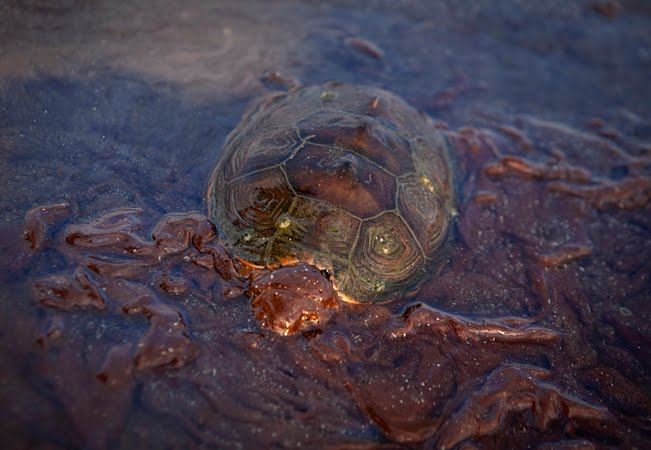
This is about as bad as it gets. Those are recent images from the Gulf of Mexico where a breached oil well has been spewing oil into the Gulf for two months non-stop. Non-stop. It is estimated that 125,000,000 gallons have flowed into the water so far, with no end in sight, Kevin Costner notwithstanding.
Imagine being a turtle or a sea bird and waking up in the morning (or whenever turtles and sea birds wake up) and finding your home awash with a substance that is the direct opposite of the water that gives you life. You look around and it is everywhere. The more you swim, the worse it gets, and you find that as you struggle your work is harder and it appears that the very work you do to extricate yourself worsens your dilemma. As an inhabitant, you are rightfully confused. What you call home is now a poison to you and it is killing you.
To accurately place yourself in their position, imagine that from above, millions of gallons of oil were poured into your house while you were sleeping. You awakened to some strange feeling but lacked the knowledge to identify it. You only knew that you were having trouble moving, breathing and it suddenly dawned on you that you could not find food and that your way of life was being threatened far beyond what any financial institution, workplace or governing body could impart on you. This is real life and death stuff.
For those of you who have the Bible as your guide, you will recall a passage where man is given dominance over the animals. It's in Genesis or one of those books near the beginning. Dominance however, does not include dumping toxic chemicals on them or encasing them in substances. There are rules, and those rules have been violated.
It is perhaps the saddest thing I have seen. A bird covered with oil, thinking, "What the f**k?" He has no idea that a world so dominated by one product would allow the production of it to endanger the very land that gave it to us. It's a strange relationship, where we pull toxins out of the bowels of our planet and use them to enhance our lifestyle. I'm not skilled enough to explore that, so I'll allow you to talk amongst yourselves.
Still it continues to flow, and the best answer we have is to drill another well to relieve the one that is leaking. Meanwhile, a part of our planet is dying.
The president was on television last week, and he stopped short of saying what I thought he should have said. He should have told us the truth. The truth isn't that BP is going to pay to clean this up or that we will kick somebody's ass or any of that political talk that sounds good on television. The truth is that this will take decades to clean up, and in the meantime, it will be as bad a disaster as we have seen, September 11 notwithstanding.
With hurricane season coming, my layman's knowledge of such matters wonders what happens if (or when) a hurricane comes through the Gulf and starts blowing wind and water out of the area. When it rains in Alabama, Tennessee and the southeast, will part of the rain contain oil from the Gulf of Mexico? I'm thinking it will and I'm thinking that our government doesn't want us to think about that, so they aren't saying anything.
But I'll say it, because I don't work for the government. Remember this when there are oil-coated cars, houses and animals inland.
Maybe I think too much.

Monday, June 21, 2010

Sudden and unexpected popularity.

It occurred to me that if Nick Drake was half as popular during his life as he is now, some 36 years after his death, he'd still be alive. It started in 1999 with that Volkswagen Cabriolet ad that used "Pink Moon" as the soundtrack and mushroomed from there. It seemed a strange way to sell a car, but I don't get paid to construct an advertising campaign.
Recently, Nick's "From the Morning" was used in an AT&T spot to promote their wireless network. I see the tie-in - don't you?
There are two possibilities for Nick's recent popularity:
1 - Ad agencies and the general public have come to realize how simple and poetic his music is, and have wised up and are using it to advertise things.
2 - The rights are cheap and it fits their purpose.
I'm guessing it's number two.
If you don't know who Nick Drake is, there is a nice write-up on his Wikipedia page that will get you started. It's a sad story and it's made sadder by the fact that he was virtually unknown while he was alive. Great art is seldom appreciated in the artist's lifetime, but there is always someone around to reap the rewards.


In case you'd like to hear the song without the advertising - as it was intended...

Sunday, June 20, 2010

The golfers.

Where have I been? The world spins, the oil still leaks, the Phillies play (just don't ask me the scores) and my postman continues to bring bills. Every so often I lose track of things.
This week was LPGA tournament week around here. The girls were playing the Shop Rite tournament in Galloway, and I was there for a couple of days walking with Paula Creamer. Sadly, I could not go back today. Partly because of time commitments and partly because it was in the mid-90s with high humidity. I reach my warmth levels quickly. Fortunately though, I do own a television.
The men are playing the U.S. Open in Pebble Beach (a far sight better than South Jersey) and once the LPGA tournament ended I switched over to the men. When you see two tournaments side-by-side like that, the differences in the two games hit you pretty quickly. The girls dress in bright colors with various accoutrement and colorful shoes and things like pink golf balls. The men - not so much.
It's still the standard slacks and polo shirt for them. Lots of drab colors and they look more like they're going to a business meeting than playing a game. And the baseball cap. Always the baseball cap. There's something odd about seeing a nicely dressed man in a baseball cap. The women - not so much. I can't imagine the PGA one day allowing men to dress in shorts. I think they would deem it disrespectful to the game. The same game the women play, by the way, and their governing body has no issues with golf's stoic tradition. It probably isn't much different than the way men and women are treated in society, so it isn't that radical.
We assign different standards to the genders, and rejoice when they are met, forgetting that we assigned the standards to begin with. Phrases like "runs well for a girl" or differentiating women athletes from men and assigning priorities to their accomplishments. It's a deeply rooted thought process, and I haven't the skills to determine its cause.
Sometimes I don't know what I'm talking about.
Paula Creamer played the first tournament of her 2010 season after coming back from a complicated thumb surgery. She wore a wrap around the thumb the entire time and engaged in stretching exercises between shots to keep it flexible. Admittedly, she played in pain. Golf is a difficult enough game without having to endure pain in the process. But that's what you do when something means so much that you would do it under great physical duress rather than sit and complain about not being able to play. Add that in to stories like this and she instantly becomes an easy person to like.
She didn't win today. She entered the last round a shot behind the leader and could only manage to shoot par for the day to finish tied for fifth. She saw me in the reception line after Friday's first round and asked "are you coming back tomorrow?" Of course I was. It's so easy to root for someone who cares so much about being the best, and it's a condition absent from a lot of pro athletes in other, more popular sports. Sports that make people crazy enough to blow a horn for the entire game, paint their face in team colors, gamble, purchase expensive souvenirs and clothing and expensive event tickets.
My Shop Rite card got me into the tournament for free. I didn't even have to pay to watch Paula play golf, and since I routinely pay $100 (all expenses) a night to watch big time baseball, you'd see why I think watching Paula is the biggest bargain in sports.
Maybe I was wrong. Maybe Paula did win today?

Wednesday, June 16, 2010

In lieu of oil, please send flowers.

A field of flowers south of Salem, NJ today. (photo by me)
NEW ORLEANS – BP began burning oil siphoned from a ruptured well in the Gulf of Mexico on Wednesday as part of its plans to more than triple the amount of crude it can stop from reaching the sea, the company said. BP said oil and gas siphoned from the well first reached a semi-submersible drilling rig on the surface of the Gulf around 1 a.m.
Once that gas reaches the rig, it will be mixed with compressed air, shot down a specialized boom made by
Schlumberger Ltd. and ignited at sea. It's the first time this particular burner has been deployed in the Gulf of Mexico.
BP officials previously said they believed the burner system could incinerate anywhere from 210,000 gallons of oil to 420,000 gallons of oil daily once it's fully operational. Work to optimize the new system was still ongoing, and the company did not say how much oil it has burned so far
.
Is burning the oil a great idea, or just the last-ditch effort from a company that has run out of ideas? What's next? Do they set the entire Gulf of Mexico on fire and burn-off the leaked oil? Maybe it's on the drawing board?
I saw the president's speech last night. Mostly, by accident, because the Phillies are playing like Little Leaguer's and my thumb started working the remote. "Oh hey, the president is on!"
He started with a recap of what happened, and if one listens between the lines, this accident is setting up to be the worst event in recent history. An eco-system is at risk, as well as jobs, a way of life and a recovery process that is going to sink the country deeper into debt at a time when we can least afford it. Don't for a minute think that BP is picking up the tab. It's nice to talk about, but let's be realistic.
What I heard was a lot of tough talk and another new bureaucratic body designed to oversee this mess - or what he termed as an "independent party" to distribute the money that BP said they are going to give the financially injured people in the affected area.
Then, he started in on the oil industry and how dependent we are on them. He said something about today being the first day of our oil independence, or something like that. He wants our best minds to work on ways to get us off the oil standard, citing wind and solar energy as possible solutions. I remember candidate John Kerry proposing just such an effort 6 years ago, and as I watched the speech, I pictured Kerry in his living room shaking his head. Kerry is a bright guy, but lacked the charisma to be elected in our TV-minded electorate.
It reminded me of the way we over-react to situations that are bad and have always been bad. Someone's ax is gored and some legislation is passed (like Megan's Law) or some social program designed to prevent something that has always been a problem.
Although, if it takes something like this to finally get the government to pull the trigger on what we call "alternative energy," then so be it. It takes a car accident to get a drunk driver to reform, a heart attack to get people to start treating their bodies right and a house fire to get them to install smoke detectors.
Maybe we can use human nature to help us - for once.

Tuesday, June 15, 2010

If 12 was 10 and 6 was 9.

The news coming out of big colleges lately is that many of them are jumping from one athletic conference to another for ... anyone ... money. That's right. Texas is staying put, however, Of course, it's not love of conference or tradition or anything as sappy as that. The good folks at Fox TV are paying the Longhorns somewhere in the neighborhood of $20 million per year while still allowing Texas to form its own, all-Longhorn network, an option it probably wouldn't have in the Pac-10... Sweet deal.
I find it odd that the same NCAA that puts schools on probation because they may have paid a student-athlete's rent or bought him a nice dinner could sanction the school making a financial deal with a TV network. It's OK for the school to make the money but not OK for the students.
Not all of the players are going to sign big NFL contracts. Some are actually attending school for an education, and it might be nice to have a decent meal once in a while that you don't have to pay for.
Maybe they can arrange for some of that $20 million to go for improved cafeteria service?
You know that the interests of the NCAA and the conference isn't pure either. How else to explain the fact that the PAC-10 just invited Texas and Oklahoma to join. For you non-sports fans, the "PAC" stands for Pacific. I think even the non-geography students in the crowd know that Texas and Oklahoma are a little east of the Pacific Ocean.
There are a lot of conferences, and they have names like the Big-10, Big-12, Pac-10 and Atlantic 10. They're big on tens. They're big on Big too. A lot of conference names start with Big, as though bigger is better. Strangely, the Big-12 has ten teams and the Big 10 has twelve. But why quibble? These people are college graduates, aren't they?
They wouldn't like it if Alabama's Mark Ingram had formed The Mark Ingram Network and charged people $4 a month to watch streaming videos of all his games. He isn't allowed to earn any money playing for schools that earn millions from his efforts. I suppose the schools think that the education they're providing makes up for the money? That may be true, but smart kids get scholarships too, and they have jobs after school and parents and friends who send them money. When you're an athlete they're called benefactors. When you're a student they're called 'people I borrow money from.'
It reminds me of a concert I attended recently, where alcohol was prohibited on the grounds and the parking area, but you were able to purchase as much as you wanted once you got into the amphitheater. It was only OK when the people in charge were making money off it.
I'll bet the people running the amphitheater are college graduates too.

Monday, June 14, 2010

We are what we buy.

There is a new VISA commercial with a huge tie-in to Disney's "Toy Story" movie, complete with requisite Disney VISA card. In the ad, a group of the Toy Story gang are running around a store. Buzz Lightyear's action figure is selected by a kid and the happy character watches the kid embrace the toy Lightyear. Throughout the ad, it's tough to tell whether it's an ad for Disney or VISA. I suppose that's the point of cross-marketing.
The thing that struck me as I watched the ad was, why do we get so upset when advertising targets kids the way they do with other products; but we don't say anything when kids are used to sell a product. A happy kid with a toy is a happy kid, even though it winds up costing the parent a hefty 22% service charge. Just don't target fatty foods to kids by marketing Happy Meals. We have determined that to be bad.

I'm seeing more ads than usual for Father's Day this year. Maybe I missed something, but suddenly, the gifts that they are peddling are upscale electronics that would cost the kids between $500 and $1,000. Stuff like LCD televisions, iPad's, laptop computers, gaming consoles and other gadgets that the folks at Best Buy or Radio Shack would be happy to sell you - for dear old dad. It's nice to know that the Father's Day people have stepped up their marketing campaign to equal that of the Mother's Day holiday. The prime message is: Love has a dollar value. But how to pay for it all?

Don't forget to use your Disney VISA card.

Sunday, June 13, 2010

Word of the day: Vuvuzela

I'm never sure what is supposed to go in this space. Sometimes I have a coherent thought that spews out onto the page rather easily. Sometimes the page is left open for hours until I can string together 500 words that make both grammatical and logical sense. It ain't always easy, gang. Today, I think I'll just spew at random, if you please.
The oil is still gushing out of that pipe in the Gulf of Mexico. You've seen it, right? The incredible thing to me is that the oil has enough built-up pressure to continue to leak out of the pipe without being pumped. That's amazing to me. It would have been great if they could just turn off a pump, but the earth is spitting it out at a pretty nice pace. I'd think that the earth would be interested in keeping it in, since it's a form of slow suicide. It is barely being collected faster than it is coming out, and it will be until Tuesday before another effort is made to stop it. The mind boggles at what effect over 100 million gallons of oil (10 times the Exxon-Valdez spill) can have in a confined and sensitive space like the Gulf. I think there are things we aren't being told because there is something environmentally devastating going on down there.

SALT LAKE CITY – Emergency workers believe they have stopped a 21,000-gallon oil leak from reaching the environmentally sensitive Great Salt Lake, one of the West's most important inland water bodies for migratory birds that use it as a place to rest, eat and breed.
But the spill has taken a toll on wildlife at area creeks and ponds, coating about 300 birds with oil and possibly threatening an endangered fish.
The leak began Friday night when an underground Chevron Corp. pipeline in the mountains near the University of Utah broke. The breach sent oil into a creek that flows through neighborhoods, into a popular Salt Lake City park, and ultimately into the Jordan River, which flows into the Great Salt Lake.
Let that be a lesson. If you're going to dump 21,000 gallons of oil into a lake, do it when 100,000,000 gallons are being dumped into the Gulf of Mexico. That's called a diversion tactic, folks.
Meanwhile...
Some great (and near-great) events are heavily tied-into alcohol consumption. Often, I wonder how popular some things would be if we couldn't tote alcohol in or consume it legally in public. We are, of course, encouraged to "drink responsibly," but if we stopped to think about it for a minute (and we will) ones responsibility is the first thing to go when we start drinking, so being responsible would be deemed impossible after a couple of drinks.
One such event is this World Cup soccer tournament that is going on somewhere in the world. People around the world love soccer, but here in America it is hard to embrace sitting through 3 hours of a sporting event to have it end in a tie. I can't conjure up any emotion over almost losing. And the noise. There's something about golf, tennis and baseball that is both competitive and tranquil. People don't spend the entire time screaming in your ear or blowing horns. ALERT: Word of the day. I'd guess that companies who make vuvuzela's (Vuvuzela's R Us, Vuzuvela Depot, Vuvuzela Hut - they're out there) see their business skyrocket every couple of years, then lay off their entire staff because, well - how many vuvuzelas does the world need? I'm guessing there's a tie-in between the vuvuzelas and alcohol.
And now, a few sobering words from U.S. Representative Jim Matheson, (D-UTAH) on Chevron's response to the oil spill in Utah:
"I would say they are responding very aggressively to it. I think they know there is a heightened concern among people in this country about oil spills," Matheson said. "I think they understand it's in their best interest to do everything they can to fix this as soon as possible."
Really? Do they? What are the consequences of not cleaning it up as soon as possible? Would we stop using their product? Sure, like that'll happen. And yes, we are concerned (even heightened concern) about oil spills. I'm not sure there ever has not been. I can't wait until "Oil Spill Awareness Day" so that we can all be reminded of the consequences of dumping a toxic chemical on animals, onto beaches and into our water supply.
I forgot.

Thursday, June 10, 2010

A real "playing field"

Ashley-Madison founder Noel Biderman sent a letter to the CEO at New Meadowlands -- obtained by TMZ -- declaring, "At this stage, we are prepared to make a preliminary offer ... of $25,000,000 for the Naming Rights for a five-year term." He adds, if the stadium gets better offers, "We would be pleased to match any such superior offer." The offer (which works out to $5 million a year) is pretty big, but it's still below the average for other stadium sponsorships -- Bank of America pays $7 million a year to sponsor the Carolina Panthers stadium and FedEx drops $7.6 a year on the Redskins stadium in D.C.
So, let's see if the gang at New Meadowlands is willing to sell naming rights to a web site that promotes infidelity. That's the real test, isn't it? To see if a professional sports franchise is honest enough to take money from a company that may not align itself with conventional thinking. Would they sell the naming rights to a company for less if that company promoted something that was in the mainstream, like cigarettes, big banking or big oil? Probably, but would that make the deal any more palatable? Probably not.
You see, sports likes to distance itself from certain things, like alcohol, even though they promote alcoholic beverages at every commercial break, and use the eraser phrase "Please drink responsibly." That makes it good, right? Suppose they decided to call it "Jesus Christ Memorial Stadium?" Would that offend anyone? Sure it would, but they wouldn't do that either.
On the home page of Ashley Madison's web site, they use the phrase "Life is short. Have an affair" as a way to sell their site to prospective customers. They say they are "The world's premier discreet dating service with over 6,190,000 members." For those of you who may not know, the word discreet, when used in that context, means that their users don't want anyone to know what they're doing - like their husbands or wives.
In fact, they gurarantee that you'll have an affair within 3 months if you sign up for the membership. If you don't, they will refund the $249 membership fee. Business must be booming, because they're offering millions to the Meadowlands stadium to put their name on the front of the building.
Of course, the Meadowlands people won't sell the naming rights to a company like Ashley Madison. They'd have a lot of questions to answer, and they don't like answering questions. After all, the porn industry makes about $10 billion a year, yet nobody would ever admit to watching a pornographic movie. People have affairs, yet none of them would ever tell anyone where they found somebody to hook up with.
That would be way too honest and above-board for anybody associated with professional sports to do. The same people who willingly participate in legalized ticket scalping, sports betting and promoting alcohol.
Why stop there?

Wednesday, June 9, 2010

30 Followers

Geez. First of all, thank you to the thirty of you who have taken the time to follow me on this little Internet voyage. If you feel like the rantings get tired, there are 4 years of stuff to search. Start going back over the things you missed since you joined me and you might think I was either (a) funnier or (b) the same as now, only older and more tired. Either way, It's been an interesting time, and I wonder where my pent-up rants would have wound up if it weren't for the Internet.
I haven't written much about the big oil spill in the Gulf of Mexico. Partly because I figure that you're already aware of it and partly because I'm at a loss to describe how I feel about it. I think I said that it would make the Exxon-Valdez look like "a Bounty commercial," but it goes beyond that now. The thing I can't figure out is how BP didn't have a plan for a pipeline break. As a driller and a major player in the oil industry, you'd think that they would have devoted at least part of their operations manual to "what to do when the pipe breaks." At least I would think that, but I suppose guys making millions of dollars a year don't have to concern themselves with such mundane problems when they can just point their fingers at someone else.
Meanwhile...
Some of the nation's largest and most elite universities stand to gain millions of dollars from selling the names and addresses of students and alumni to credit card companies while granting the companies special access to school events, the Huffington Post Investigative Fund has found.
The schools and their alumni associations are entitled to receive payments that multiply as students use their cards. Some colleges can receive bonuses when students incur debt.
When I was in college, I remember seeing credit card applications plastered on the bulletin boards at gathering places, and I wondered, "How can these kids afford a credit card, and how can they even get one when some of them have no income?" How naive I was. What I failed to realize was that the very people who were providing me with an education were also profiting from the banks who issued the cards to their students. As though it wasn't enough to rape them for $50,000 a year for tuition, they had to include credit card fees into the equation.
For granting such access and information, schools can receive royalty payments based on the number of students opening accounts and the amount they spend, the contracts show. Most of the schools are entitled to earn more whenever a student carries a balance from year to year. Some consumer advocates question whether colleges participating in affinity agreements are failing to safeguard the young people in their care.
"Universities should place the welfare of their students as their highest priority and shouldn't sell them off for profit," said Ed Mierzwinski, consumer program director for the federation of state Public Interest Research Groups, or PIRG.
Obviously, it isn't enough to make kids and their parents pay through the nose for an education. Some colleges (mine probably included) think that it is necessary to profit from debt as well. Shame. That doesn't discourage the banks from rationalizing their actions...
The contracts call for a range of minimum payments by banks. At Brown, Bank of America agreed in 2006 to pay $2.3 million over seven years. At Michigan, the bank in 2003 agreed to pay $25.5 million over 11 years. The bank says it's not taking advantage of students; it's amassing new customers whose loyalties can span a decade or more.
"Our objective in serving the student market is to create the foundation for a long-term banking relationship," Bank of America spokeswoman Betty Riess said in an email, adding that the bank offers reasonable rates and low credit limits on student cards, and that it primarily solicits graduates and sports fans.
Of course, they're not taking advantage of students. They are merely acquainting them (or educating them, in college parlance) in the ways of the world. If they can't learn from mounting debt, what can they learn from?
The University of Michigan alumni association, facing growing scrutiny from consumer groups, says it reached an agreement with Bank of America to stop marketing to students in early 2008. Jerry Sigler, chief financial officer of the alumni association, said he made the decision begrudgingly.
"Managing credit is as much a part of education and maturation as anything else going on campus," he said. "Credit isn't bad, it's a reality."
The benefits are not always so obvious for students whose families already face soaring tuition costs and hefty loan payments. College seniors graduated in 2008 with average credit card debt of more than $4,100, up from $2,900 four years earlier, according to data compiled by student lending company Sallie Mae.
Well, at least the alumni association (emphasis on the "ass") has the students' best interests at heart, right? Sure, only after "growing scrutiny." There's a life lesson for you kids. And managing credit is a part of maturing, until it becomes too big to manage, which is where Bank of America and their cronies figure in. Books are expensive, so why not CHARGE it? At 20% interest, you'll learn quickly how to manage credit.
From a bank's perspective, students represent an important demographic: Not only do many first-time cardholders hunger for credit; they are likely to stay customers for quite some time - up to 15 years, according to a 2005 study by Ohio State University researchers.
"Student credit cards are hugely important to a bank," said Kerry Policy Groth, who negotiated collegiate affinity agreements as an MBNA account executive from 1998 to 2005. "Your first credit card is usually the one you keep."
It's the one you keep because it's the one you can never pay off. Never look at anything from a bank's perspective. It makes you cross eyed.
"Building a future customer--that was really the goal" of affinity agreements, said former MBNA executive Groth. "You're not out to gouge them; you want a positive experience."
But if you do gouge them, you're not going to feel badly about it, are you? After all, you're building a future customer - for the next 50 years until the debt is paid off. Thanks for doing us all a favor, you blood-sucking bastards.

Tuesday, June 8, 2010

The glamour of misery.

Site of the Woodstock Music and Arts Fair, seen from just in front of the monument off Hurd Road in Bethel, NY. (Photo by me)
I was almost 12 years old in August of 1969. My recollection of the Woodstock music festival is enhanced by television and movies, and I'm not sure how much I remember and how much I learned over the years. I had a nice record collection as a kid, but almost none of the artists who appeared at Woodstock. The music of my childhood was limited to what was played on Top 40 radio, and almost none of the music of Woodstock was Top 40 stuff.
I was in Saratoga Springs, New York for a Dave Matthews concert over the weekend. The return included a side trip to Bethel, the site of the Woodstock Music and Arts Fair. The town of Woodstock is about an hour away, but it's too boring to tell you why it was called Woodstock. Just go with it.
The photo above shows the site of the concert. The stage was where the gravel area is to the left, and the hoards of people stood on the grass area to the right, up the hill. Beyond that is the site of the Bethel Woods Center for the Arts, which is a fancy name for an amphitheater. Inside the Center is the Woodstock museum, which is a fancy name for something that makes money off history.
The Center and amphitheater are fairly new. The museum was built 2 years ago, and the amphitheater about 5 years ago. It's a beautiful place, but it's difficult to get to. Although not nearly as difficult as it was 41 years ago when nearly a half-million people descended on this little town (population 2,700 in 1969) to spend three days taking drugs and listening to music.
The organizers expected about 150,000 so to say they underestimated is an understatement. In addition to running out of food, they didn't have nearly enough toilets; it rained like Hell twice; the New York Thruway was closed, (trapping travelers on the road and causing even more potential attendees to turn around) the locals were stuck in their houses for three days, cars were parked all over the streets and after the concert the field was stewn with trash. Otherwise, it was a great weekend. Some of the music was great, but most of it was poorly performed, and the artists who went on at night could not be seen because of the lack of lighting and occasional power outages.
All of those things are dulled by time, and the subsequent film made it seem like an adventure, which I suppose it was. Take yourself back 41 years and leave your cell phone, WiFi Internet connection and e-mail at home. It seems charming in the hindsight of history, but many of those who were there were miserable. Imagine if the promoters hadn't filmed the concert (which they almost didn't) or recorded the music for posterity. All we would have are faded memories and the healing power of time. Fortunately for the folks who still own the production rights, they did film it and record the music, otherwise how would anyone continue to make money off it?
We like to look back on misery and glamorize it. The 1960s were violent and politically turbulent times. What we like even more is trying to duplicate something and make money off it. Subsequent festivals (Altamont comes to mind) tried but failed to revive the feeling. But we quickly learn that feelings cannot be revived, and sometimes, things that happen once do so for a reason, and the serendipity of the event is its charm.
Movie sequels are often grim reminders of how good the original was, reunited bands make us long for our youth and television programs often last longer than they should because people want to milk money out of something that was once good - or something historic that we remember differently than the actual experience. That's part of the odd experience of places like the Holocaust Museum, war memorials, battle sites and those bouquets and crosses people put on the side of the road where a loved one died in an automobile crash. We're funny with the way we remember misery.
Perhaps more of our historical sites and commemorative places glorify misery than happiness. That's strange, isn't it?

Friday, June 4, 2010

Don't drink the water.

LOS ANGELES (AP) - Cadmium has been discovered in the painted design on "Shrek"-themed drinking glasses being sold nationwide at McDonald's, forcing the burger giant to recall 12 million of the cheap U.S.-made collectibles while dramatically expanding contamination concerns about the toxic metal beyond imported children's jewelry.
The U.S. Consumer Product Safety Commission, which announced the voluntary recall early Friday, warned consumers to immediately stop using the glasses; McDonald's said it would post instructions on its website next week regarding refunds.
Ironically, the cadmium-infested glasses are the third-most nutritious McDonald's menu item.
Tobacco smoking is the most important single source of cadmium exposure in the general population. It has been estimated that about 10% of the cadmium content of a cigarette is inhaled through smoking. The absorption of cadmium from the lungs is much more effective than that from the gut, and as much as 50% of the cadmium inhaled via cigarette smoke may be absorbed.
On average, smokers have 4-5 times higher blood cadmium concentrations and 2-3 times higher kidney cadmium concentrations than non-smokers.
So -- they can sell cigarettes, but Shrek glasses have to be recalled. That makes good nonsense. I wonder what the potential damage is from second-hand drinking glasses?

Thursday, June 3, 2010

Nothing is perfect

Screws fall out all the time. The world's an imperfect place.
- John Bender, "The Breakfast Club"
Screws fall out, things break, people fail and umpires make bad calls. In case you dropped out of an airplane today and missed the big news, an umpire blew a call and a kid in Detroit lost a perfect game because of it. Now, people who otherwise wouldn't know who Armando Galarraga is are trying to get him something that he lost, after first base umpire Jim Joyce missed a call with two out that wound up costing the kid his perfect game.
It's a shame it had to happen to him, but baseball, by its design is human-element prone. Players make errors, batters strike out and umpires make mistakes. None of them happen at the best of times. Sometimes, they happen when the situation is the most crucial. However, we can't make exceptions when the bad call or error costs the team some place in history. A win is a win, and a "perfect game" means more than just the pitcher getting everybody out. Perfection has something to do with the umpires too. They need to get every call right, otherwise it isn't a perfect game. It's imperfect.
Major League Baseball didn't step-in and reverse the Steve Bartman play in that Cubs game in 2003 or Jeffrey Maier interfering with a 1996 ALCS Orioles/Yankees playoff game. This game wasn't nearly as important.
Meanwhile, Galarraga is more famous for not doing something than he ever would have been for doing it, to the point that a car dealer in Cleveland gave the guy a Corvette (above) for not pitching a perfect game. Try not doing something in your life and expecting a reward. Sports is screwy.
Suppose Joyce had decided to make an 'out' call at first base regardless of whether he thought the guy was safe or out? If replay had shown the runner to be safe and Joyce had called him out, how would that have contributed to history?
People who want Major League Baseball to step in and reverse the call aren't looking at the big picture. To wit:
MACKINAC ISLAND, Mich. (AP) — Michigan Gov. Jennifer Granholm has issued a proclamation that says Detroit Tigers pitcher Armando Galarraga pitched a perfect game against Cleveland, despite an umpire’s blown call.
Granholm issued the proclamation Thursday, one day after first base umpire Jim Joyce declared a runner safe with two outs left in the ninth inning, costing Galarraga a perfect game. After seeing the replay, Joyce said he blew the call and apologized to the pitcher for not realizing Cleveland’s Jason Donald didn’t beat the throw to first base.
Granholm tweeted about the blown call after the game and on Thursday told WJR radio that Galarraga “was robbed.”
Sen. Debbie Stabenow is also urging baseball commissioner Bud Selig to declare Galarraga’s performance perfect, and Rep. John D. Dingell says he’ll introduce a congressional resolution asking Major League Baseball to overturn the call.
Whenever government gets involved in sports, you know you're in for trouble. Regardless of any political grandstanding (check to see if those reps are up for re-election in the fall) Selig, as dopey as he is, can't step in and reverse a call. It's just a call. Should Selig reverse every stupid call that an official scorer makes? They make plenty of dopey calls. I challenge Senator Stabenow and Governor Granholm to name ten Tiger players by first and last name. We've all been "robbed" Jennifer. Some of us don't have baseball teams to play for and big news stories to push, so maybe you should be working as hard for your constituents as you do for a guy making a million dollars a year.
The world is an imperfect place, and regardless of technology, we can't control everything that happens. Deal with it.

Wednesday, June 2, 2010

Twitface.

I like Twitter better than Facebook, because I'd rather have followers than friends.
I'm not sure what the attraction is with either of these "social networking" sites, but I cling to them like lint to my fine fabrics, which isn't always a good thing.
The thing about Twitter, I find, is that there is a social hierarchy to it. In other words, the higher up the social (or political or entertainment) ladder one is, the more followers one has, and the less one has to devote time to the followers. As a leader, you post your thoughts and the others read them and listen. There are probably @ replies, but the leader isn't necessarily obligated to reply because, after all, he is the leader and you are the follower. You are put in your place. That's the part of Twitter that bothers me, since I find social hierarchy disturbing. By default, what a celebrity (or leader) Tweets is more interesting than what I do, and that isn't always the case, especially the way some of them rabble on about nonsense in their lives.
At least Facebook has a social equity. However, some folks have seen to make it a political platform, and I have been forced to un-friend them because I get drawn into the political discourse. Those folks would be better off with a blog where they could dispense their politics without interrupting the social atmosphere and making others uncomfortable. Here, I can opine on issues and you expect to hear an opinion. On Facebook, your expectation is that you will hear about the latest life issue or event affecting your life, not the current political climate and its affect on you. Social boundaries are good sometimes.
There is something to be said for Twitter's 160-word limit but less to be said for its construction as a caste system. While they're limiting the characters, they could also limit the number of Tweets per day. I don't need to know about your "awesome cab ride" or the "cool bracelet I just bought." Sum it up later in the day, if at all. You're not as interesting as you think you are.
I'm not sure I want 3,000 friends either, which is what Facebook encourages. "You might know [this person] who also knows [another person]," and we're supposed to add every friend request we get. What that means is that your Home page is filled with the personal observations of everyone on your Friends list, and that's too much for me to take sometimes (most times). As in real life, I can get along quite well with three or four good friends better than I can with 50 acquaintences. It's easier for me to focus on their needs and interests if I don't have to think about what their friends are doing. Life is confusing enough.
Perhaps Facebook should limit friends the way Twitter limits characters (pun). That would force us to choose actual friends from "friends of friends" and others who know you because you're someone else's friend. Most of the time, I find myself tracing friend requests back through two or three people before I ultimately ignore it. Ignoring friend requests is the last great vestige of the Internet. We can choose to ignore people and they are forced to accept it.
If only life were as simple as the Internet makes us think it is.

Monday, May 31, 2010

What it Means to be an American

It's the unofficial start of summer, a big day for barbecuing, a great day to find a cheap piece of furniture or grab a big sale somewhere and a day off from work for most of us. However, the disgusting abundance of retail businesses that are open today is a concept I don't quite grasp.
While I realize that there is more money to be made by being open on a holiday than not, I would think that a sense of history and respect would prevent it. Maybe it is because so many businesses are owned by non-native Americans that keeps them open, I don't know. I could assume it is simple greed, and I would at least be partly correct.
In the United States, today is Memorial Day, which we have been celebrating in one form or another since 1866. It used to be called Decoration Day, but was officially declared Memorial Day in 1967. Until 1968 it was celebrated on May 30, but the U.S. Government passed the Uniform Holidays Bill, and it was moved to the last Monday in May.
And therein lies part of the problem. No less a group of Americans than our federal government believes that the long weekend is more important than the holiday. When the priorities of the government are to extend workers' weekends at the expense of tradition, how can we expect TD Bank to be closed? Those of us who are old enough to remember that the country would pretty much shut down on a holiday find the new system a bit hard to take. Would it kill the supermarket to close today? As far as they are concerned, it is more important to meet their quarterly earnings than it is to pay respect to people who died for us.
Memorial Day is not only a day off from work, it is a symbolic gesture to remember people who died because they were called to duty by their government. The very government who changed the rules in favor of big business. We have no other way to thank them, and the least we could do as Americans is sacrifice a precious day of revenue for the sake of the men and women who helped make it possible for you to have revenue to begin with.
Is that too difficult a concept to grasp?

Friday, May 28, 2010

Now what?

President Obama: "Hey, come here and smell my finger!"
OK, so it isn't very funny, but then again, neither is thousands of barrels of oil spilling into the Gulf of Mexico. You know you're in trouble when three people in business-casual clothing are walking the beach with police tape in the background.
That's the shitty part about being president, or the CEO of British Petroleum for that matter.
Somebody makes a big mistake and you're left walking the beach picking up clumps of washed-up oil trying to think of something to say to the American public that won't make it sound like the Gulf coast is about to become the world's biggest waterproof beach.
Such is the peril of delegated authority.

Wednesday, May 26, 2010

Robots on Mars.

That's the view from behind the Mars rover called Opportunity. Tracks laid across the Martian landscape will be there for centuries. Things like that make me think. You're not surprised.
Centuries ago, Galileo peered at Mars through his telescope and declared that there were canals on the planet. He surmised that they were once waterways that had since dried up, and since, scientists have wondered if there was ever water on Mars. Reasonable men may differ.
So now, we have sent a robot to the planet to roam around and explore, leaving tire trails in its wake. Centuries from now, will astronomers be peering at Mars through their telescopes and wonder if ancient civilizations existed on Mars? Suppose records of life on Earth are destroyed by an asteroid or comet, like in the movies, and there is no record of us sending a probe to explore the planet. Wouldn't that make Galileo look even smarter?
Perhaps we're all just as intelligent as the time allows? Isn't that why we thought our parents were super-human when we were 8, but later saw them as doddering idiots, incapable of managing their own lives, let alone ours? That's the cosmos in microcosm.
Look back at your old high school yearbook photos or photographs of yourself as a youngster. You thought you were hip and attractive, didn't you? Now, you look like an incredible geek with giant hair and giant shoes, pants that are too tight and shirts with more colors than a rainbow. You thought nothing of it then, and might have been proud to march out the door looking like that in the quest for a mate. How foolish you were.
What are the three things that have stood the test of time? Short haircuts, tan pants and white shirts. If you had invested in those in the 1970s and kept them until now, your look would only have changed based on your age. Otherwise, you'd look like everybody else. But you decided that tight designer jeans, bright nylon shirts and tall shoes were the order of the day. You bought them because you were a slave to fashion, and the desire to fit-in superseded your instincts. Maybe you thought you looked silly, or worse, you thought you looked hip. Either one is a path toward obsolescence, and seeing photos of yourself reminds you of how silly you were. Meanwhile, the "geeks" in the science club with their white shirts and tan pants are suddenly practical in your eyes. Strange.
The next time you're wandering the American Eagle store or perusing the racks of Aeropostale, ask yourself how you want to be seen in 20 years. Ask yourself if you'd like to have photos of your "pants on the ground" or your giant t-shirt left on your grandkid's Facebook page. I don't think you will. So, settle for the white shirt, tan pants and black shoes. Some things never make you look silly.
That's what I think about when I see a photo from a robot on Mars.

Tuesday, May 25, 2010

The dilution of our expectations.

"To you I say, it is only with adversity that we even have a chance at greatness. Adversity is your opportunity."
- Ann Curry
One of the downsides of expansion - be it sports or media - is the dilution of talent. More teams or more networks translates into more opportunities to hire nitwits and incompetents. Now that there are a thousand news outlets and only so many eligible talking heads, one wonders what the talent level has become for big media. Ask no longer:

After taking the stage to launch into the school's 175th commencement address, "Today" show co-host Ann Curry sought to drive home the inspirational content of her speech by ticking off the names of a few of the school's more illustrious alums. Among the entries on the Curry honor roll: "60 Minutes" correspondent Lesley Stahl, evangelist Billy Graham, slasher-film director Wes Craven, and United Airlines Flight 93 passenger Todd Beamer. There was just one problem: Apart from Stahl, everyone on that list actually graduated from another Wheaton College, the Christian liberal-arts college in Wheaton, Illinois.

It's not like it was 40 years ago when there were 3 major networks, and people like Walter Cronkite, Dan Rather and David Brinkley wrote and read the news. Now, there are too many networks to count, and the communications graduates are setting lower standards for writing, reading and presence. It's only apparent if you're old enough to remember when network television news was a major source of information and the people bringing it to you had our respect. Now, not so much.

It would seem that
Ms Curry's address was done with the help of Wikipedia or some other web site rather than her own knowledge, which explains a lot about how she got to host a big-time TV show. Oh - and in her apology letter to Wheaton College, she misspelled the name of Lesley Stahl, spelling it Leslie. So, there's twice the egg and only one face. Nice going, Ann. Hey, at least they all attended college. That's a feather in your cap.

Now, I see that "American Idol" is down to two. One named Crystal Bowersox and another named Lee DeWyze. I saw them on Saturday's Fox baseball game strumming guitars and singing "Take Me Out to the Ballgame." Impressive? I don't know. I'd figure that there are a hundred-thousand people in the country who could strum a guitar and sing that song as mundanely as they did. So, why is it necessary for a major network television show to parade them around for 12 weeks and give them a recording contract as a reward? It's needless ceremony, and I suppose if America hasn't awakened to the concept by now, they never will. Based on what I saw, I don't see stardom for either of these people, but then, America is lured by hype, and nobody ever lost money underestimating the intelligence of the general public, so I imagine they will go on to multi-million selling CDs and foist-upon popularity based on a TV show that should have long ago died a slow, agonizing death.

Forgive my run-on sentence.

Monday, May 24, 2010

Pickers and Pawners

The History Channel is branching out. No longer is it enough to show Hitler documentaries and profiles on our American presidents (usually during President's Day weekend or July 4). They have expanded to shows about pawn shops and junk collectors. One such program is called American Pickers, which I suppose is to highlight the American part and appeal to historians because these guys go around picking trash for a profit.
There are two aspects to the program that are interesting. One is the idea that people collect things in their homes and garages, and it sits there for some reason or another. The Pickers guys come along and offer money for it in the hopes of restoring it and re-selling it at a profit. That's where the American part comes in.
The other aspect is the extent to which we (you) retain the junk of our (your) past. In the show I saw tonight, a guy had a house full of old cigar cutters, big-wheel bicycles and advertising signs doing nothing but collecting dust in his basement. He was reticent to part with most of it. The show doesn't go into the reasons. They're only interested in buying what they can and making the most profit possible from it.
At first, it seems like the pickers are taking advantage of the hoarders. Maybe they are, but one wonders why they're hoarding the stuff in the first place. Why would someone hold onto a collection of old light bulbs or Harley Davidson catalogs? My motto is, if it has sat long enough that I haven't looked at it in over a year, I'm not getting any benefit from having it around. Out it goes.
The other group that amazes me are the people who come into the pawn shop on Pawn Stars. They have a valuable piece of Americana and they have decided to sell it to a pawn shop in Las Vegas for half of its value. When the pawn shop owner has an expert come in to tell the seller what the item is worth, there is usually an expression of amazement, as though the seller had no idea that the Revolutionary War bond he was peddling was worth the same amount as the car he drove to the pawn shop.
There is a psychological aspect to these programs that goes beyond their face value. These are people who kept things from their past and either had no idea of its worth or no intention of parting with it until the right TV show came along. They are both entertaining programs, but I can't help but wonder why the sellers allow themselves to be exploited.
A guy came into the pawn shop and sold an old Seeburg jukebox for a few hundred dollars. The pawn shop sent it to a local restoration house and had it restored, and sold it for three times what they bought it for. Why didn't the original owner do that? Part of me feels badly for the sellers because they are being taken advantage of by the pickers and pawners. They are obviously lured by the quick buck and can't be bothered with the effort involved in restoring something that has value, preferring to sell a worn out piece of junk rather than restore it themselves and sell it for a bigger profit.
American Pickers and Pawn Stars fall under the category of "reality TV," and I suppose the reality part is that people are generally lazy, and if you're hungry enough, the lure of a quick buck will supersede the inherent value in the item you're selling. That's a harsh dose, right there. Let a couple of guys raid your garage for old gas station signs and bicycles or allow someone to sell a piece of American history for pennies on the dollar and you too can have your own TV show, proclaiming it to be part of "History."
But what is it, in reality?